How to install Dell Mobile Connect app on any Windows 10 device


Dell Mobile Connect
Image Courtesy: Dell.com
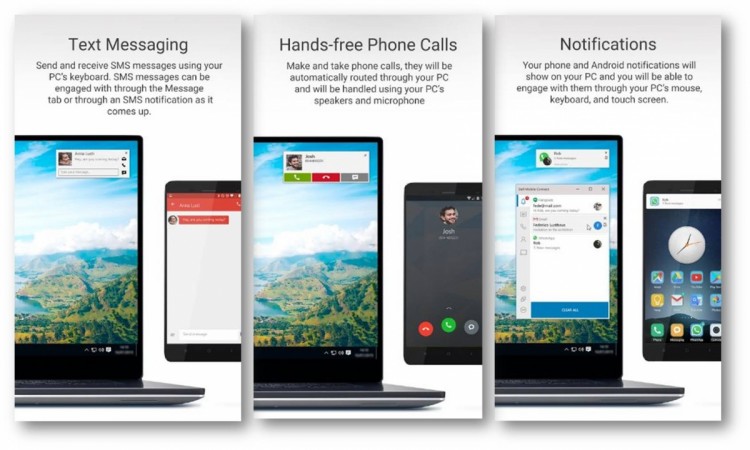
Dell recently introduced Windows 10 ‘Continuum’ like feature called Mobile Connect at CES 2018. The Mobile Connect app comes with the new laptops recently launched by Dell. The feature lets you connect your Android or iOS device to your PC via Bluetooth and you can send, receive messages or calls on your PC.
However, this feature was exclusive to Dell PCs at the launch but not anymore. A simple trick lets you install the app on your PC. Here’s how to install Mobile Connect app on any Windows 10 PC:
  • Make sure that the Developer Mode is on. To do that go to settings > Update and Security > For Developers -> turn on Developer Mode.
  • Wait for few minutes for the developer package to be installed.
  • Download the .appx package of the Dell Mobile Connect App from here.
  • After downloading, install the package by just double-clicking the file.
  • The App Installer would pop up and click Install button to install the app and wait for it to finish.
Now in order to be able to use the app, you may also need to install the drivers provided by Dell. Here’s how you can do that:
  • Download the drivers from here.
  • After downloading, open the .exe file.
  • Instead of clicking the Install button, click the Extract button and extract to the folder that you want to extract to.
  • After the extraction is successful, close the dialog box.
  • Go to the folder where you extracted the files.
  • Run the DellMobileConnectDriversSetup.exe as administrator.
  • Click yes if prompted.
  • Go through the setup and install the drivers.
  • After installation is completed, press Finish.
Make sure you’ve downloaded Dell Mobile Connect app on your mobile from Play Store on Android 5.0+ and App Store on iOS 10+. After installing, go through the linking process between both devices and you are good to go.

Comments

Popular posts from this blog

How To Install IDM Integration Module Extension in Microsoft Edge?

First and foremost, ensure you’re using the latest version of IDM and check ‘Edge’ and ‘ Use Advanced Browser Integration’ options are selected in IDM General preferences. Install IDM Integration Module in Edge Visit about: flags, select ‘Enable extension developer features’ checkbox under ‘Developer Settings’ Restart Edge browser for the changes to apply. Click on … more menu and select ‘Extensions’ Click ‘Load extension’, browse and navigate to  IDMEdgeExt  folder under ‘C:\Program Files (x86)\Internet Download Manager’ and click ‘Select Folder’ IDM extension will be installed and activated. Click on IDM Integration Module to see its status (On or Off) and permissions are given to it. After that, if you play a video in Edge browser, you’ll see the download panel as shown in the screenshot below.

How To Install IDM Integration Extension in Any Browser Manually

1. All you need to do is visit IDM installed directory in Program files, here is its path for navigation in Explorer “C:\Program Files\Internet Download Manager”. 2. And drag-n- drop  IDMGCExt.crx  extension onto Chrome://extensions page or you can open that page by Chrome menu>Tools>Extensions. That’s it IDM Integration extension will be installed for chrome.  *Make sure you checked ‘Hide Extensions for Known file types’ on Folder Options dialog to see IDMGCEXt with crx extension .

How To: Why is VirtualBox only showing 32 bit guest versions on my 64 bit host OS?

My Host OS is a 64-bit version of Windows 10, VirtualBox categorically refused to display any 64-bit guest OS in the  Create Virtual Machine  dialog box. This was super annoying because all my ISOs were 64-bit therefore I couldn’t use them until I fixed this problem. Uninstalling and reinstalling VirtualBox made no observable difference so I booted into the BIOS to see what I could find there. I have a HP Pavilion g6 2231tx.  As a side note, a few months ago I made another idiotic mistake: I enabled a bunch of BIOS passwords to make myself feel  secure  but then forgot how to disable them! Thank God I didn’t enable a  Supervisor Password  or else I would have to replace the system board.  That’s seriously the only way to get around that one; resetting the CMOS won’t fix a forgotten Supervisor password.  Thankfully, I remembered, the Hard Drive password and the Power-On Password, so after surmounting those obstacles,...