
How to Enable Android Nearby Sharing on Google Chrome for Windows 10

 The Nearby Sharing is available in only the Dev and the Canary build of Google Chrome. But we hope that this feature will come to the regular version soon and everyone can use it without installing the dev build. If you want, here is a step by step guide to tell you how you can enable this feature on Google Chrome.

Steps to Enable Nearby Sharing on Google Chrome

  1. Download and install the Google Chrome Dev version on your Windows PC. You can also install the Chrome Canary if you want.
  2. Now open Google Chrome(Dev or Canary) browser and navigate to chrome://flags.
  3. Here, search for “nearby”, and a search will popup called Nearby Sharing.
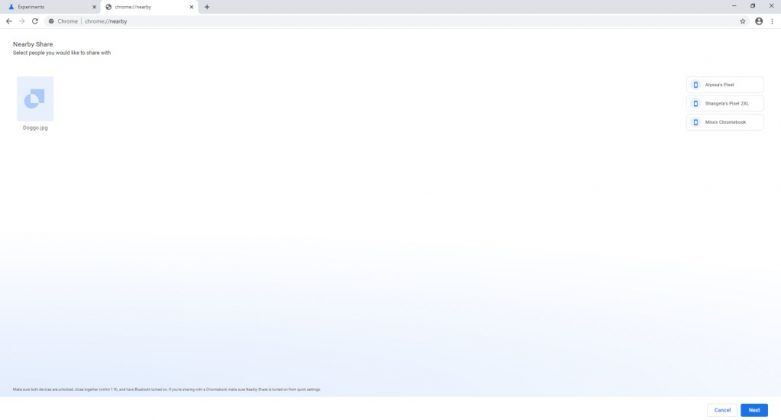
  4. Enable that feature from this page and it will ask you to relaunch the browser.
  5. Even if does not ask you to relaunch the browser, restart the browser after enabling the Nearby Sharing feature.
  6. Once you relaunch the browser navigate to chrome://nearby to enter nearby sharing user interface.
You can now enable nearby sharing on Google Chrome and share the files between your PC and your smartphone using this feature enabled. This is a really great future if this makes it up to the regular version of Google Chrome.

Comments

Popular posts from this blog

How To Install IDM Integration Module Extension in Microsoft Edge?

First and foremost, ensure you’re using the latest version of IDM and check ‘Edge’ and ‘ Use Advanced Browser Integration’ options are selected in IDM General preferences. Install IDM Integration Module in Edge Visit about: flags, select ‘Enable extension developer features’ checkbox under ‘Developer Settings’ Restart Edge browser for the changes to apply. Click on … more menu and select ‘Extensions’ Click ‘Load extension’, browse and navigate to  IDMEdgeExt  folder under ‘C:\Program Files (x86)\Internet Download Manager’ and click ‘Select Folder’ IDM extension will be installed and activated. Click on IDM Integration Module to see its status (On or Off) and permissions are given to it. After that, if you play a video in Edge browser, you’ll see the download panel as shown in the screenshot below.

How To: Why is VirtualBox only showing 32 bit guest versions on my 64 bit host OS?

My Host OS is a 64-bit version of Windows 10, VirtualBox categorically refused to display any 64-bit guest OS in the  Create Virtual Machine  dialog box. This was super annoying because all my ISOs were 64-bit therefore I couldn’t use them until I fixed this problem. Uninstalling and reinstalling VirtualBox made no observable difference so I booted into the BIOS to see what I could find there. I have a HP Pavilion g6 2231tx.  As a side note, a few months ago I made another idiotic mistake: I enabled a bunch of BIOS passwords to make myself feel  secure  but then forgot how to disable them! Thank God I didn’t enable a  Supervisor Password  or else I would have to replace the system board.  That’s seriously the only way to get around that one; resetting the CMOS won’t fix a forgotten Supervisor password.  Thankfully, I remembered, the Hard Drive password and the Power-On Password, so after surmounting those obstacles,...

How to Use File Explorer Without a Mouse on Windows 10

Windows 10’s file manager is packed with  keyboard shortcuts . You can launch  File Explorer  and use it entirely with your keyboard—without ever touching a mouse. It’s no  Norton Commander , but it’s extremely keyboard-friendly. Launch File Explorer To launch File Explorer from anywhere on your Windows system, press Windows+E. You can also use other keyboard shortcuts—for example, if File Explorer is the first icon from the left on your Windows 10 taskbar, you can  press Windows+1  to activate that taskbar button. If it’s the third icon on your taskbar, you can press Windows+3 to activate it. Navigating Folders File Explorer will open to the Quick Access view when you launch it. Use the arrow keys to select files and folders and press Enter to enter folders or open files. To expand a collapsed section (like “Devices and drives” under “This PC”), select it and press the Right arrow key. To select a file or folder in a directory, start ty...